
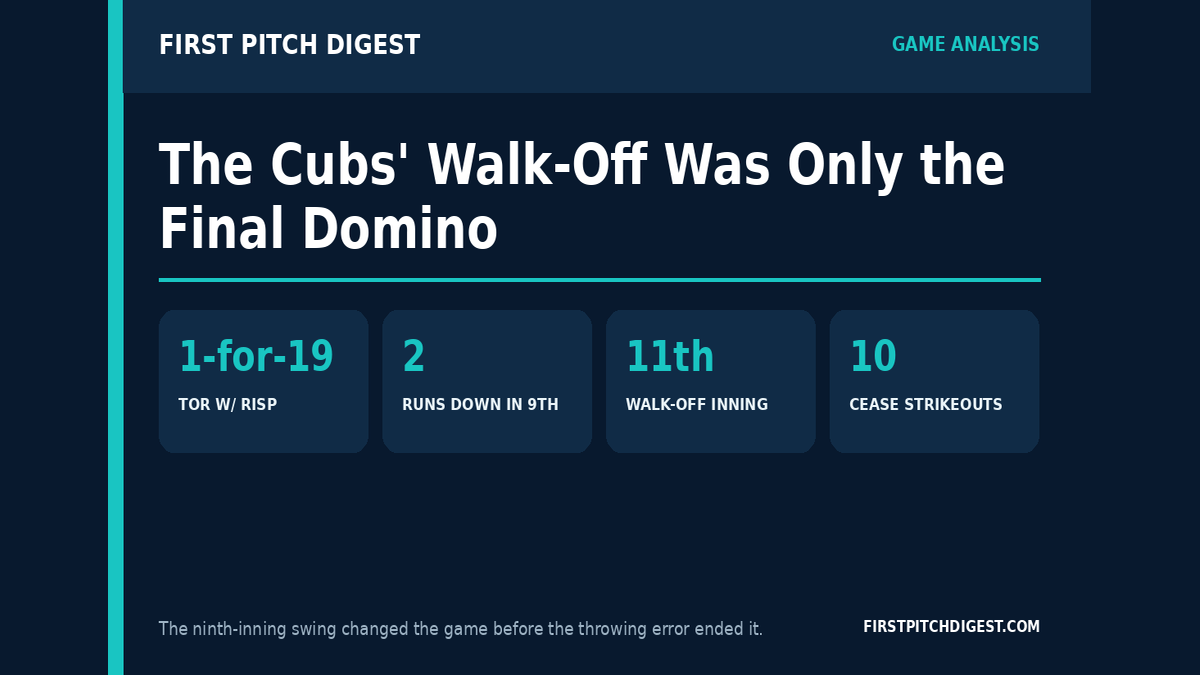
The Cubs’ Walk-Off Started Long Before the Throwing Error
Walk-off wins are usually remembered for the swing that ended them, a single frozen image, bat connecting with ball, that gets replayed on highlight shows and referenced for years afterward. Thursday night at Wrigley Field produced a walk-off win with no such image at its center. The Cubs beat the Blue Jays without a walk-off hit at all. The winning run scored on a throwing error during an attempted stolen base in the bottom of the 11th inning, after Pete Crow-Armstrong broke for third base and Toronto catcher Brandon Valenzuela’s throw sailed into left field.
That ending is memorable purely on its own strange terms, the kind of finish that generates conversation precisely because it’s unusual rather than because it’s dramatic in the conventional sense. But focusing only on the final play undersells what actually decided this game. Blue Jays closer Louis Varland entered the ninth inning protecting a two-run lead, with the Cubs down to their final strike and seemingly out of realistic ways to extend the game. Alex Bregman took a curveball deep to tie it, Varland’s first blown save of the season. Everything that followed, the scoreless tenth, the jumping catch, the eventual walk-off on an errant throw, was a direct downstream consequence of that single swing turning what looked like a finished game back into a live contest.
The dominant start that became a footnote
Blue Jays ace Dylan Cease had one of his best outings of the season working through the middle innings, seven scoreless innings with 10 strikeouts and only two hits allowed heading into the eighth. A start of that quality usually results in a win regardless of what the rest of the roster does around it, the kind of pitching performance that’s supposed to make a team’s night close to automatic. Instead, it became little more than a footnote by the time the game actually ended, erased first by one swing in the ninth and then buried further by a throwing error two innings later that had nothing to do with anything Cease himself had done on the mound.
There’s something worth sitting with in that sequence. Cease did essentially everything a starting pitcher can be asked to do, dominating opposing hitters for seven full innings while allowing next to nothing. And the game still slipped away from his team regardless, a reminder that even the best individual pitching performance in baseball is only ever one component of a nine-inning, or in this case eleven-inning, team effort. A start this dominant losing anyway is precisely the kind of outcome that reveals how much of a baseball game’s final result sits outside any single player’s control, however well that player performs his own specific job.
The number that explains the loss better than either single play
Toronto went 1-for-19 with runners in scoring position across the full game, a number that explains more about the eventual outcome than either the blown save or the throwing error does in isolation. A team leaving that many scoring opportunities on the table across a full game rarely wins it, regardless of how dramatically or unusually the final out actually happens to arrive. The blown save and the throwing error are the two plays that will get remembered and replayed, since they’re the kind of discrete, visually dramatic moments that highlight packages are built around. But a 1-for-19 mark with runners in scoring position is the quieter, more comprehensive explanation for why Toronto found itself in a position where either of those two plays could sink the game in the first place.
This is worth emphasizing because it’s a pattern that shows up constantly in baseball and gets underweighted constantly in how games get discussed afterward. The single dramatic play that ends a game is rarely the entire story of why that game ended the way it did. It’s usually the final domino in a longer chain of missed opportunities that made the team vulnerable to exactly that kind of dramatic swing in the first place. A team hitting well with runners in scoring position throughout a game typically builds enough of a cushion that one blown save or one uncharacteristic error doesn’t decide the outcome on its own. A team going 1-for-19 in those situations leaves itself perpetually exposed to precisely this kind of finish.
Reading the win probability arc across all eleven innings
A proper accounting of this game requires thinking about it as a full arc of win probability shifting across all eleven innings, rather than as a handful of isolated highlight moments. For most of the game’s regulation length, Toronto was the team positioned to win, carrying a lead built on Cease’s dominant pitching and holding it deep into the game. The Bregman home run represents the single largest win probability swing of the night, instantly flipping a near-certain Toronto win into a tied game with real uncertainty restored. From that point forward, the game essentially reset into a coin-flip contest, with Ernie Clement’s jumping catch in the tenth representing Toronto’s best remaining chance to end the threat and close it out before the Cubs ultimately capitalized in the eleventh.
Viewed this way, the story isn’t really about a walk-off throwing error at all, interesting as that specific play is on its own. It’s about a two-run, two-strike deficit in the ninth inning representing the actual turning point of the entire game, with everything that followed simply playing out the consequences of that single swing across two additional innings of baseball.
What this says about the two teams’ broader seasons
The context surrounding both teams adds another layer worth understanding. Toronto entered the night sitting well below .500, in last place in a competitive division, and had recently sold pieces at the trade deadline rather than buying, a signal that the front office had already begun looking past this particular season toward the following year. A game like this one, lost on a blown save and a throwing error after seven dominant innings from the staff ace, fits a broader pattern that tends to define difficult, transitional seasons: individual moments of real quality undone by the accumulated small mistakes that separate a competitive team from a genuinely good one.
The Cubs, by contrast, entered the night in the middle of a real playoff push, sitting comfortably in position for a wild-card spot and continuing a stretch of strong recent play. A win like this one, unconventional and somewhat fortunate in how it actually arrived, is exactly the kind of game that competitive teams tend to find a way to win more often than teams playing out a lost season, not because of any mystical quality of championship-caliber teams, but because sustained competitive positioning tends to correlate with the kind of situational execution, capitalizing when an opponent blinks, that decided this specific game in the final innings.
Why unconventional walk-offs deserve the same analytical treatment as conventional ones
There’s sometimes an instinct to treat a walk-off decided by a defensive mistake as somehow less legitimate or less analytically interesting than one decided by a clean swing, as though the game found its ending almost by accident rather than through the two teams’ actual performance. That instinct doesn’t hold up well under scrutiny. A stolen base attempt succeeding or failing is itself a product of real skill and real risk assessment, Crow-Armstrong’s decision to run and his read on the specific situation, the throw’s placement, the split-second physical execution required to make an accurate throw to third base under pressure. A throwing error isn’t a random event dropped into the game from outside. It’s the product of a specific, high-pressure baseball play that could have gone either way, the same as any swing of the bat.
Treating this walk-off as somehow less meaningful than a home run would misunderstand what actually happened. The Cubs created the opportunity by putting a runner in position to force exactly this kind of high-pressure throw, then capitalized when the pressure produced a mistake. That’s a real baseball skill, forcing opponents into difficult decisions under duress, even if the final box score entry reads differently than a walk-off single or home run would.
The stolen base attempt itself deserves scrutiny
It’s worth examining the decision to attempt a steal of third in that specific situation at all, since the play only existed because someone made an aggressive baserunning choice rather than playing it safe. With a runner already in scoring position and a game tied in extra innings, the conventional, lower-risk approach would often be to stay put and wait for a base hit to drive the run in conventionally. Choosing instead to attempt an additional base, with all the risk that a caught stealing at third in that situation would carry, reflects a specific read on the catcher’s arm, the pitcher’s delivery time to the plate, or simply a calculated bet that the aggressive play offered better expected value than the passive one. That the bet paid off, in this specific case through a Toronto misplay rather than a clean stolen base, doesn’t retroactively make the decision to attempt it any less sound at the moment it was made.
Worth watching
This game is a strong candidate for a full win probability chart spanning all eleven innings, since the shape of that chart would tell a more complete and more interesting story than the box score alone. It’s also worth tracking whether Varland’s outing here represents an isolated blown save or the start of a broader late-season workload concern for Toronto’s bullpen, particularly on a team that’s already signaled, through its trade deadline behavior, that it’s beginning to plan past this current season rather than around salvaging it.