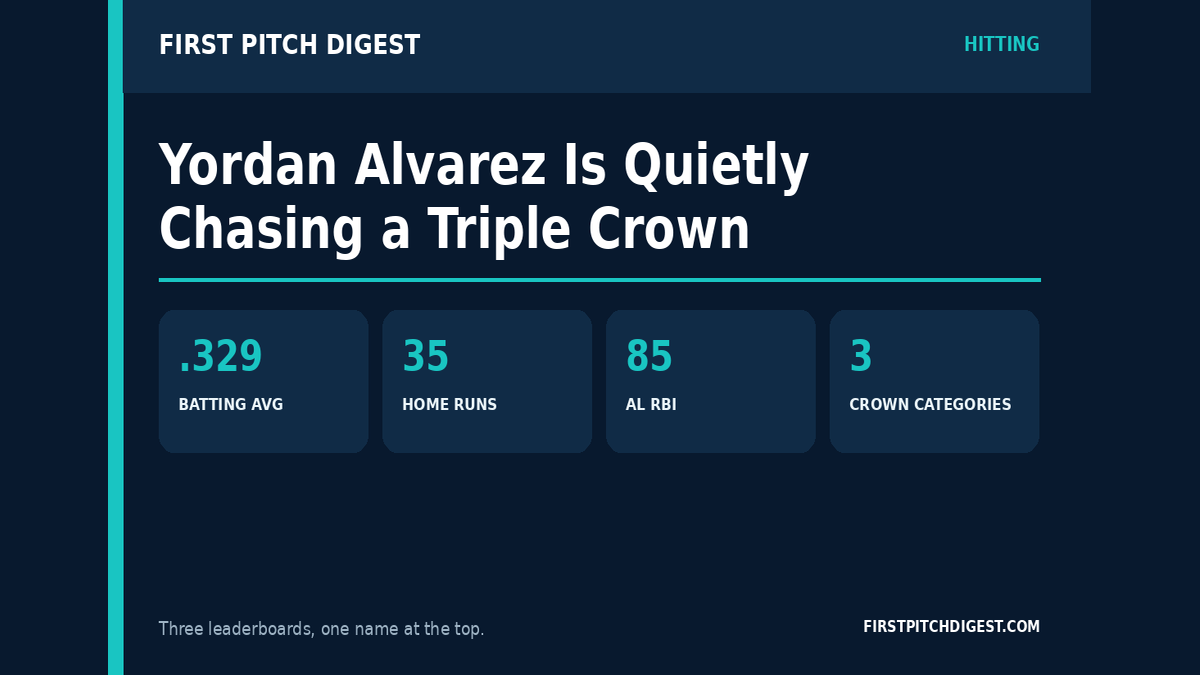
Yordan Alvarez Is Hiding a Triple Crown Chase in Plain Sight
There is a particular kind of baseball achievement that used to define entire eras and now shows up so rarely that most fans under forty have never watched one happen in real time. A Triple Crown season, leading the league in batting average, home runs, and RBIs simultaneously, is not just difficult. It requires a hitter to excel at two offensive philosophies that usually pull in opposite directions, sustained across six months rather than a hot week. Miguel Cabrera’s 2012 season remains the most recent example, and before that, the sport went forty-five years without one. Right now, quietly, Yordan Alvarez is in position to end that drought again, and the conversation around him has stayed strangely muted.
Entering play on August 6, Alvarez led all of Major League Baseball in batting average at .329 and in home runs with 35. He also led the American League outright in RBIs at 85. Three leaderboards, one name at the top of each, and remarkably little noise being made about it outside of Houston.
Why the silence is itself interesting
Part of the explanation is structural. Triple Crown chases tend to get loud in September, when a handful of plate appearances can swing a batting title and every RBI carries playoff-race weight. In early August, three months of a season still stand between now and any real crowning of the achievement, and a three-category lead, however commanding, still has room to erode. Sports media has learned, reasonably, not to spend its loudest coverage on races that could quietly dissolve by Labor Day.
But there’s a second, more interesting explanation buried in the shape of Alvarez’s season itself. He isn’t producing a spike in one category that happens to coincide with modest leads in the other two. He is leading two of the three categories by a real margin, not a percentage point. That’s a different kind of season than the tight three-way races that usually generate this conversation. A tight race invites daily tracking because the outcome feels uncertain and mutable. A commanding lead, paradoxically, sometimes gets less daily attention precisely because it feels closer to settled, even though nothing in a six-month baseball season is ever actually settled until it’s over.
What makes this specific combination rare
Batting average and home run totals do not typically move in the same direction across a full season, and understanding why requires thinking about what each statistic actually rewards. Batting average rewards contact rate and quality of contact on balls in play, which tends to favor hitters who make consistent, controlled swings and adjust to what a pitcher gives them. Home run totals reward power output and a willingness to sell out for loft and distance on the pitches a hitter can drive, which tends to favor a swing built for damage over one built for precision. Most hitters who lead the league in one of these categories are, almost by the physics and approach involved, giving something up in the other.
Alvarez leading both at once, while also leading his league outright in RBIs, means he’s doing three things that pull against each other in most swings, and doing all three at an elite level for five months running. That isn’t a fluke of a hot stretch. A hot stretch can inflate a batting average for a few weeks or produce a burst of home runs in a good month against soft pitching. It cannot, on its own, sustain a season-long lead in three categories that require fundamentally different swing decisions pitch to pitch. Whatever Alvarez is doing at the plate this year, it’s working across every situation a pitcher can present him, not just the ones that favor one particular approach.
The RBI number deserves its own scrutiny
Of the three legs of a Triple Crown, RBIs are the one most dependent on context outside a hitter’s direct control. A player can post an outstanding season and still finish well down the RBI leaderboard if the hitters in front of him in the lineup aren’t reaching base at a high rate, since there’s simply nobody on to drive in. Alvarez leading the American League in RBIs says something about him, but it also says something about the Astros lineup constructed around him, and about how often his teammates are putting him in position to do damage.
That doesn’t diminish the number. Driving in runners still requires actually hitting the ball with authority when they’re on base, and plenty of hitters with strong overall numbers underperform their opportunities in exactly this category. But it does mean the RBI total is the leg of the three most likely to shift based on factors beyond Alvarez’s own swing, injuries ahead of him in the order, a slump from the leadoff spot, a stretch of games against a bullpen that pitches around him with runners on. The batting average and home run totals are cleaner reflections of what Alvarez himself is doing, largely insulated from what happens around him.
What history suggests about late-season Triple Crown races
The two most recent Triple Crown winners, separated by nearly half a century, both maintained meaningful leads deep into their respective seasons rather than making a sudden late charge from behind. That’s not universal, and plenty of near-misses have come down to the final week. But it does suggest that a real Triple Crown season tends to announce itself early and hold, rather than materialize out of nowhere in September. Alvarez sitting atop two of the three leaderboards in early August, by real margins rather than fractions of a point, fits the pattern of the seasons that actually finish the job more than it fits the pattern of a late surprise.
That’s not a guarantee. Cold Augusts happen. Injuries happen. A month-long slump against a stretch of tough pitching could close the gap in either counting stat quickly. But if the historical shape of successful Triple Crown chases means anything, it’s that leads this size, this deep into a season, are worth taking seriously rather than treating as a curiosity that will fade with the calendar.
Why this deserves more attention than it’s getting
Baseball has a habit of under-covering excellence that doesn’t announce itself with theatrics. A walk-off home run generates a highlight package regardless of what it means in the broader standings. A batting average that ticks up two points in a quiet Tuesday afternoon game against a last-place team generates nothing, even if it represents the same underlying quality of performance sustained over months rather than compressed into one swing. Alvarez’s season has been built on exactly that kind of quiet consistency, which may be part of why the sport hasn’t fully reckoned with what it’s watching.
There’s also a simpler explanation worth considering honestly: the Astros, while competitive, haven’t been the season’s most talked-about team, and individual chases tend to draw more attention when they’re attached to a team already dominating the news cycle for other reasons. A Triple Crown chase happening inside a quieter team storyline doesn’t get the same amplification as one happening inside a pennant race drawing daily national coverage, even when the underlying individual achievement is identical.
What a completed chase would actually mean
It’s worth pausing on why this specific achievement carries the weight it does, since the term gets used loosely enough in casual conversation that its rarity can get lost. A batting title happens most seasons. A home run title happens most seasons. Leading the league in RBIs, on its own, happens most seasons too. None of those, individually, is remarkable at the level Alvarez is performing at right now. What makes a Triple Crown different is that it requires all three to belong to the same player in the same year, and the sport has restructured itself in ways that make that increasingly hard to pull off.
Modern pitching development has produced deeper bullpens, higher average velocity, and more specialized relief usage than existed in earlier eras when Triple Crowns were more frequent. Hitters today face a wider variety of looks across a single game than hitters faced decades ago, which theoretically should make it harder to sustain excellence across the specific combination of skills a Triple Crown demands. That Alvarez is doing it anyway, in an era built to make it harder rather than easier, adds weight to how the achievement should be read if it holds.
There’s also a legacy dimension that’s easy to overlook in the day-to-day tracking of a single season’s stat lines. Players who complete Triple Crown seasons tend to be remembered for that season specifically, sometimes above and beyond the rest of an otherwise excellent career. It becomes shorthand, a single word that captures an entire year’s dominance without needing further explanation. If Alvarez’s season holds, this year becomes the sentence people reach for first when describing his career, regardless of what else he accomplishes afterward.
The counterargument worth taking seriously
None of this is to say the outcome is close to guaranteed, and it’s worth engaging honestly with the version of this story where it doesn’t happen. Batting average, in particular, is the most volatile of the three legs over any given six-week stretch. A player hitting .329 in early August can just as easily be hitting .305 by mid-September if a stretch of tough pitching or a minor nagging injury affects his timing even slightly. Home run totals are somewhat more stable month to month, since power tends to be a more consistent skill than contact quality, but a real slump can still cost a hitter four or five home runs across the stretch run if pitchers start attacking him differently once the lead becomes widely known.
There’s also the question of what opposing pitching staffs do once a Triple Crown chase becomes a mainstream storyline rather than a quiet one. Once national coverage catches up to what’s happening, pitchers and coaching staffs across the league start planning specifically around denying a hitter the numbers, pitching more carefully in RBI situations, avoiding the zone more often late in games, accepting a walk rather than risking the pitch that pads a home run total. That shift in approach from the opposition is real and has affected past chases in their final months. Alvarez’s relative quiet right now may, ironically, be working in his favor, since a chase that hasn’t fully entered the national conversation yet hasn’t triggered that defensive shift from opposing coaching staffs in full.
Worth watching
Two numbers matter more than the third from here. The RBI total, as the leg most tied to lineup context around him, is the one to watch with the most skepticism, since it can shift for reasons that have nothing to do with Alvarez’s own performance. The batting average and home run total are the two that will tell the real story of whether this holds, since both are almost entirely a product of what Alvarez does at the plate himself, largely insulated from who’s on base or who’s hitting behind him.
If both hold through September, the conversation around this season will change quickly and loudly, the way these things tend to once a chase gets close enough to the finish line that broadcasts start building segments around it. Until then, the quiet version of the story is this: one of baseball’s best hitters is doing something almost nobody has done in over a decade, and doing it without much of anyone outside his own clubhouse treating it as the story it actually is.